GUEST BLOG: The power of reciprocity
Refugee women in Wales tackling barriers to education and employment
 Article by Dr Camila Montiel McCann and Professor Marie Gillespie (The Open University)
This year, on International Women’s Day, it feels more important than ever to acknowledge and celebrate the power of collaboration among women to effect change. At a time when hostility towards refugees in the UK is ever more normalised, we reflect on what we have learned from our research on how refugee women in Wales tackle the many barriers they face through practices of generous mutual support and reciprocity.
Our ground-breaking collaboration between OU researchers, refugee women and the Welsh Refugee Council is grounded in the principle of reciprocity – sharing our knowledge and encouragement with others is key. Through processes of mutual exchange – where individuals and communities both contribute and benefit – knowledge, resources, and support are collectively generated, enabling refugee women to flourish while strengthening the wider community.

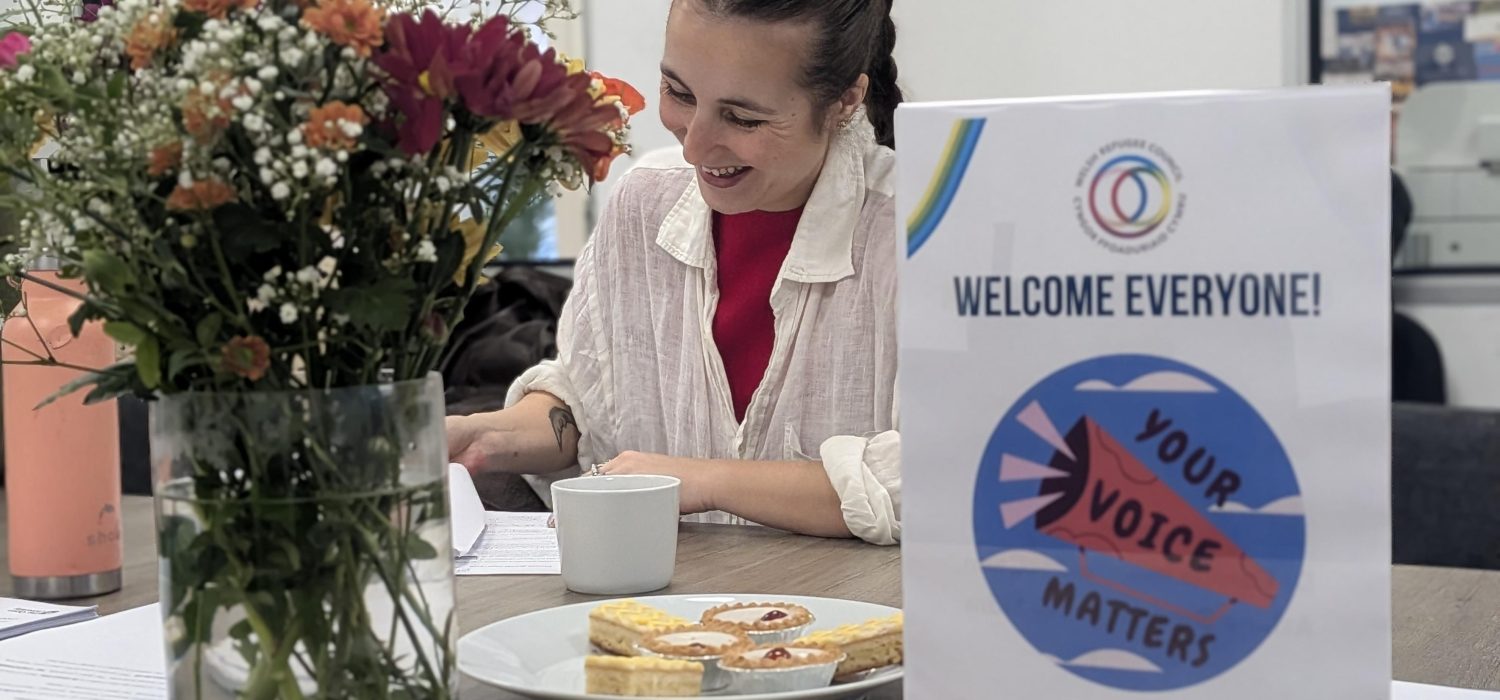
Since last September we have conducted focus groups, facilitated by our partners at the Welsh Refugee Council, in Cardiff, Swansea and Newport, where women come together to talk about their struggles and come up with solutions that can lead to meaningful education and employment – where they are able to progress, develop new skills and feed their ambition, as all women should be able to do.
The focus groups are not just research. The women we work with are not just participants from whom we extract information. They provide valuable insights and knowledge. We provide safe spaces where, often for the first time, women can talk to other women in similar positions and share their experiences and aspirations to make life better not just for themselves but for others. Time and again, the themes of mutual support, collaboration, community, reciprocity emerge as fundamental to ‘balancing the scales’ – to opening up opportunities and creating solutions.
Solutions we have already begun to develop in collaboration with the WRC range from plans to co-create a Welsh national network of support and information for refugee women, to the provision of more tailor-made approaches to ESOL that enable women to learn English while at the same gaining other skills. Many women of course also bring with them a huge range of important skills that could be mobilised for the benefit of the wider community, from teaching and practicing medicine, to jewellery-making and hairdressing.
Using trauma-informed research methods, our project is sensitive to the power imbalances that often exist between researcher and researched and reflected on the trauma that refugee women have been through, with Women for Refugee Women finding that the majority of women refugees have experienced gender-based violence. To add to this, navigating the UK-asylum system often has re-traumatising effects on women. Throughout our project, we have worked with the WRC to ensure that safeguarding protocols are strictly adhered to and that the experiences and voices of the women we work with are at the centre of our work. This approach to research goes beyond standard ethical procedures and requires a much deeper engagement in self-reflection of our own position and principles of reciprocity.
Both OU researchers and colleagues at the Welsh Refugee Council either have lived experience or a family member with lived experience of migration and/or seeking sanctuary. In every focus group, we begin with one basic rule: anything we ask of the women refugees who attend, we as researchers and facilitators must also be willing to share. Rule number two: we actively listen and hold space for the often-devastating experiences of discrimination, trauma and isolation that we hear from the women we work with. But, and perhaps more importantly, we also hold space to uplift their resilience. After sharing lunch together, we focus on solutions – asking ourselves and each other: what would have made and what could make things easier? How can we support the wide array of ambitions of these women, amongst whom we have met biomedical scientists, mothers, sociologists and artists, and how can we work together to build something better for our neighbours?
Because refugees are our neighbours. The women we have spoken to face barriers that are shared amongst many women in Wales and the UK more broadly. The costs of childcare, in a context where 25% of Welsh women must leave employment due to caring responsibilities, are also prohibitive for refugee women, who are often forced into destitution by a hostile asylum system. Experiences we have heard of misogyny from public service providers and unfair expectations about the division of labour from family members resonate with many of us as we face a political environment in which women are increasingly talked of as if our only function is to breed.
Progress for women is not possible without collaboration and reciprocity – learning from each other and co-producing knowledge about barriers and solutions is the key to success. The solutions we have developed with refugee women are also solutions that would help Welsh women access education and employment: cheaper bus tickets and family options, opportunities to learn skills within childcare-friendly hours, spaces for women to meet and share their ambitions, saying out loud to one another “this is who I want to be and where I want to go”. As I reflect on my own identity as the daughter of a refugee, this apparently small gesture is, I note, in fact the centre of our work – the more we as women see other women push to fulfil their ambition, the more we see the possibilities of fulfilling our own.
We face a political environment in which politicians claim perhaps more than ever to support women’s rights, at the same time as they increasingly support open assaults on rights to seek asylum which will undoubtedly exacerbate such violence against refugee women.
Our project is rooted in women supporting other women, across language, culture, religion and place of birth, and we hope we can be a model for both future research as well as for collaboration in the women’s rights space more broadly, one rooted in respect, reciprocity and self-reflexivity.
The project is based in the Department of Sociology. Dr Camilla Montiel McCann is the lead OU researcher on the project and the academic lead is Professor Marie Gillespie. It is an OSC project based in Sociology at The Open University.